Fiveo1
Evan Winter · Avalon, CA · Global Intelligence & Analysis
12.436651, -86.875910 · 2026-05-21 16:10:39
May 21, 2026
12.436651, -86.875910 · 2026-05-21 16:09:57
May 21, 2026
Live Recording 2026-05-20 21:39:02
May 20, 2026
Live Recording 2026-05-20 21:39:33
May 20, 2026
12.436852, -86.875317 · 2026-05-19 14:04:18
12.436852, -86.875317
May 19, 2026
12.436852, -86.875317 · 2026-05-19 14:03:41
12.436852, -86.875317
May 19, 2026
Live Recording 2026-05-19 00:42:25
May 19, 2026
Live Recording 2026-05-19 00:41:36
May 19, 2026
Indonesia — The Lock
<p>Standing silently in the hallway. His pack beside him. Preparing to leave.</p>
<p>He observed his surroundings. The adjoining rooms lay silent as he passed through the capital — arriving only the day before. The sun had not yet risen on the new day. A mist lingered in the air. A refreshing coastal breeze touched his skin. The world was still asleep. And Potter was about to wake it.</p>
<p>He approached the wall of locked boxes. A rainbow of multi-colored locks against individual steel-blue security doors. A petty fortress of other people's valuables, each lock a promise of safety. Each lock a lie.</p>
<p>The opportunity was too much to pass up.</p>
<p>He positioned himself at his starting point. One last moment of calm. Emotion and empathy absent. Not because he was a monster. Because in this moment, he could not afford them. Emotion makes you slow. Empathy makes you hesitate. Hesitation gets you caught.</p>
<p>He positioned the lock in his hand, partially obscuring it from the view of anyone who might interrupt his endeavor. A trick he had learned years ago — hide the act in plain sight. Most people see what they expect to see. A man checking his own lock. A traveler securing his belongings. No one looks twice at a key turning in a lock.</p>
<p>No one looks at all.</p>
<p>The tensioner now positioned at the base of the lock port. His thumb carefully applying the pressure needed. A simple set of tools he had fashioned out of stainless steel tweezers in Kuala Lumpur. Broken in half. One half shaped into an "L." The other given a slight bend at the end and filed down to provide an astonishingly effective key. A lock pick born from garbage. A skeleton key from a medical kit.</p>
<p>His right hand inserted the simplistic tool.</p>
<p>The feel of notches and grooves at his fingertips. The travel lock — a truly false sense of security. The majority only needing one or two pins pressed before giving way. Cheap metal. Poor manufacturing. The illusion of safety sold to millions who never tested it.</p>
<p>Potter tested it.</p>
<p>Positioned at the back, the thinly fashioned key passed over the pins. Back and forth. A gentle dance of tension and pressure. The furthest pin pressed into place and held. The correct tension — the solution to every lock. Too much pressure and the pins bind. Too little and they slip. Just right, and the world opens.</p>
<p>His hand felt the subtle sensation of movement. Additional pressure giving way. The key port shifted slightly. The telltale sign he was heading in the right direction.</p>
<p>One more pin. Two at most.</p>
<p>Then the lock would surrender.</p>
<p>—</p>
<p>Potter — a bit of a pirate in truth. The need to be close to the sea ran through his veins like salt water. He possessed a collection of talents unusual to most. Lock picking. Free diving. Spearfishing. The ability to disappear into a crowd and emerge somewhere else entirely. These were not hobbies. These were survival mechanisms. His reality.</p>
<p>The island of Sri Lanka — just south of India — was not originally on his list of must-see destinations. His travel companion in Bali had suggested they go there together after Indonesia. A very driven Filipina-American from Las Vegas. The perfect body to go with her ever-consuming drive to conquer the social media world and build her social influencer empire.</p>
<p>Her name was Sam.</p>
<p>They had met a few weeks earlier at a very tropical resort-style hostel. Ice-cold beers poolside. Various travelers coming and going on their journeys from every walk of life. Zooming off for their days of adventure exploring the beautiful, vast island of Bali. Crystal-clear, picture-perfect sandy beaches. Glorious coastal sunsets. Vast jungles hiding gems of every sort. All explored on rented mopeds that cost five dollars a day.</p>
<p>Sam had been backpacking for a year. She was attempting to pave her way to social media influencer. A successful businesswoman in her late twenties, she owned a handful of homes that she managed as rentals to fund her endeavor. She refused to accept the status quo of life — the 9-to-5, the mortgage, the quiet desperation of suburban existence. Instead, she chose to adventure the world, documenting her very sexy figure along the way in an astonishingly vast collection of itty-bitty, teeny-weenie bikinis, sexy tube tops, and short shorts. All of it packed into a single travel pack.</p>
<p>Potter was a happy camper along for the ride. The eye behind the lens. Something he was actually good at. He had a selective eye for the best settings and environment, capturing exceptionally dynamic shots that brought envy from the eyes of other photographers. He made her look amazing. She made him feel useful. They made a good team during their short time together.</p>
<p>A few short weeks. But a lifetime of adventure.</p>
<p>—</p>
<p>Before Sam. Before Bali. Before the locks.</p>
<p>Potter had been working his way through Malaysia, crossing by ferry into the northern tip of Indonesia. Stepping off the relatively short jaunt across the sea, he found himself uncertain of his next steps. The humidity hit him like a wall. The smells — spices, exhaust, salt, sweat — overwhelmed his senses. The language shifted around him, unfamiliar sounds bouncing off unfamiliar buildings.</p>
<p>He hailed the first motor bike taxi. Hopped on the back.</p>
<p>"Take me to the bus station, please," he said to the pint-sized driver.</p>
<p>The driver nodded. They zoomed off into traffic that defied all logic — a chaotic ballet of honking horns, swerving scooters, and pedestrians who valued destination over life.</p>
<p>—</p>
<p>The lock surrendered.</p>
<p>A soft click. Almost inaudible. The kind of sound that travels only inches before disappearing into the ambient noise of the world. No one heard it. No one turned. No one saw Potter slide the door open and reach inside.</p>
<p>He would be gone before the sun fully rose.</p>
<p>He was always gone before the sun rose.</p>
<p>—</p>
<p>This story continues in "Chicken Bus Indonesia."</p>
<p>What happened next involved two drivers, a pregnant woman, an old woman who may have died, forty-eight hours of Arabic music, and a bus full of actual chickens.</p>
<p>But that is another chapter.</p>
<p>For now, know this: Potter got on that bus. He survived that ride. And somewhere in the chaos between the lock and the bus and the island and the woman who would change his trajectory, he discovered something about himself.</p>
<p>He was not a good man. He was not a bad man. He was a man who could pick a lock in the dark, catch a bus at dawn, and outrun his own conscience for days at a time.</p>
<p>Whether that made him free — or just alone — was a question he did not ask himself.</p>
<p>Not yet.</p>
<p>Not there.</p>
<p>Not under that mist, in that hallway, with that lock still warm in his hand.</p>
<p>—</p>
<p>To be continued in "Chicken Bus Indonesia" — the ride from hell, the Day of Silence, and the cold Bintang beer that made it all worthwhile.</p>
<p>He observed his surroundings. The adjoining rooms lay silent as he passed through the capital — arriving only the day before. The sun had not yet risen on the new day. A mist lingered in the air. A refreshing coastal breeze touched his skin. The world was still asleep. And Potter was about to wake it.</p>
<p>He approached the wall of locked boxes. A rainbow of multi-colored locks against individual steel-blue security doors. A petty fortress of other people's valuables, each lock a promise of safety. Each lock a lie.</p>
<p>The opportunity was too much to pass up.</p>
<p>He positioned himself at his starting point. One last moment of calm. Emotion and empathy absent. Not because he was a monster. Because in this moment, he could not afford them. Emotion makes you slow. Empathy makes you hesitate. Hesitation gets you caught.</p>
<p>He positioned the lock in his hand, partially obscuring it from the view of anyone who might interrupt his endeavor. A trick he had learned years ago — hide the act in plain sight. Most people see what they expect to see. A man checking his own lock. A traveler securing his belongings. No one looks twice at a key turning in a lock.</p>
<p>No one looks at all.</p>
<p>The tensioner now positioned at the base of the lock port. His thumb carefully applying the pressure needed. A simple set of tools he had fashioned out of stainless steel tweezers in Kuala Lumpur. Broken in half. One half shaped into an "L." The other given a slight bend at the end and filed down to provide an astonishingly effective key. A lock pick born from garbage. A skeleton key from a medical kit.</p>
<p>His right hand inserted the simplistic tool.</p>
<p>The feel of notches and grooves at his fingertips. The travel lock — a truly false sense of security. The majority only needing one or two pins pressed before giving way. Cheap metal. Poor manufacturing. The illusion of safety sold to millions who never tested it.</p>
<p>Potter tested it.</p>
<p>Positioned at the back, the thinly fashioned key passed over the pins. Back and forth. A gentle dance of tension and pressure. The furthest pin pressed into place and held. The correct tension — the solution to every lock. Too much pressure and the pins bind. Too little and they slip. Just right, and the world opens.</p>
<p>His hand felt the subtle sensation of movement. Additional pressure giving way. The key port shifted slightly. The telltale sign he was heading in the right direction.</p>
<p>One more pin. Two at most.</p>
<p>Then the lock would surrender.</p>
<p>—</p>
<p>Potter — a bit of a pirate in truth. The need to be close to the sea ran through his veins like salt water. He possessed a collection of talents unusual to most. Lock picking. Free diving. Spearfishing. The ability to disappear into a crowd and emerge somewhere else entirely. These were not hobbies. These were survival mechanisms. His reality.</p>
<p>The island of Sri Lanka — just south of India — was not originally on his list of must-see destinations. His travel companion in Bali had suggested they go there together after Indonesia. A very driven Filipina-American from Las Vegas. The perfect body to go with her ever-consuming drive to conquer the social media world and build her social influencer empire.</p>
<p>Her name was Sam.</p>
<p>They had met a few weeks earlier at a very tropical resort-style hostel. Ice-cold beers poolside. Various travelers coming and going on their journeys from every walk of life. Zooming off for their days of adventure exploring the beautiful, vast island of Bali. Crystal-clear, picture-perfect sandy beaches. Glorious coastal sunsets. Vast jungles hiding gems of every sort. All explored on rented mopeds that cost five dollars a day.</p>
<p>Sam had been backpacking for a year. She was attempting to pave her way to social media influencer. A successful businesswoman in her late twenties, she owned a handful of homes that she managed as rentals to fund her endeavor. She refused to accept the status quo of life — the 9-to-5, the mortgage, the quiet desperation of suburban existence. Instead, she chose to adventure the world, documenting her very sexy figure along the way in an astonishingly vast collection of itty-bitty, teeny-weenie bikinis, sexy tube tops, and short shorts. All of it packed into a single travel pack.</p>
<p>Potter was a happy camper along for the ride. The eye behind the lens. Something he was actually good at. He had a selective eye for the best settings and environment, capturing exceptionally dynamic shots that brought envy from the eyes of other photographers. He made her look amazing. She made him feel useful. They made a good team during their short time together.</p>
<p>A few short weeks. But a lifetime of adventure.</p>
<p>—</p>
<p>Before Sam. Before Bali. Before the locks.</p>
<p>Potter had been working his way through Malaysia, crossing by ferry into the northern tip of Indonesia. Stepping off the relatively short jaunt across the sea, he found himself uncertain of his next steps. The humidity hit him like a wall. The smells — spices, exhaust, salt, sweat — overwhelmed his senses. The language shifted around him, unfamiliar sounds bouncing off unfamiliar buildings.</p>
<p>He hailed the first motor bike taxi. Hopped on the back.</p>
<p>"Take me to the bus station, please," he said to the pint-sized driver.</p>
<p>The driver nodded. They zoomed off into traffic that defied all logic — a chaotic ballet of honking horns, swerving scooters, and pedestrians who valued destination over life.</p>
<p>—</p>
<p>The lock surrendered.</p>
<p>A soft click. Almost inaudible. The kind of sound that travels only inches before disappearing into the ambient noise of the world. No one heard it. No one turned. No one saw Potter slide the door open and reach inside.</p>
<p>He would be gone before the sun fully rose.</p>
<p>He was always gone before the sun rose.</p>
<p>—</p>
<p>This story continues in "Chicken Bus Indonesia."</p>
<p>What happened next involved two drivers, a pregnant woman, an old woman who may have died, forty-eight hours of Arabic music, and a bus full of actual chickens.</p>
<p>But that is another chapter.</p>
<p>For now, know this: Potter got on that bus. He survived that ride. And somewhere in the chaos between the lock and the bus and the island and the woman who would change his trajectory, he discovered something about himself.</p>
<p>He was not a good man. He was not a bad man. He was a man who could pick a lock in the dark, catch a bus at dawn, and outrun his own conscience for days at a time.</p>
<p>Whether that made him free — or just alone — was a question he did not ask himself.</p>
<p>Not yet.</p>
<p>Not there.</p>
<p>Not under that mist, in that hallway, with that lock still warm in his hand.</p>
<p>—</p>
<p>To be continued in "Chicken Bus Indonesia" — the ride from hell, the Day of Silence, and the cold Bintang beer that made it all worthwhile.</p>
Indonesia
May 12, 2026
He Had Made Friends
<p>He had made friends in town. It had only been six months or so, but it felt right. A place to call home.</p>
<p>That was until today.</p>
<p>Standing there. Barefoot. Shirtless. Handcuffs hanging from his wrists. His other hand clutching a body camera — at least he had that. The moon illuminated the night sky. It was a beautiful evening. The kind of evening that mocks you when everything has gone wrong.</p>
<p>How did he get here?</p>
<p>Let me start at the beginning.</p>
<p>—</p>
<p>It was a short flight from Spokane, Washington to Cancun, Mexico. The next stop on my early retirement at thirty-eight. On the road for a few years, hopping from country to country, exploring the sights. No schedule. No boss. No one telling me where to be or when.</p>
<p>I had just finished a nine-month tour of Mexico on my Kawasaki Vulcan 1500. Crossed from Texas to Monterrey, then down to Tampico, over to Mexico City. Thousands of miles of desert and mountain and coast. The kind of ride that strips you down to your essentials. Just you, the bike, and the road.</p>
<p>I was hit by a truck in Guadalajara. Spent a month there recovering. Then two months in Puerto Vallarta. By an act of God — or maybe just decent Mexican insurance — the driver was insured. They repaired the bike back to new. I rode up to Sinaloa, over to Ensenada, and down the Baja Peninsula to one of the most beautiful places on earth.</p>
<p>I spent a month there doing absolutely jack shit. Smoking weed. Fishing. Watching the sun set over the Sea of Cortez. Beautiful beaches. Gorgeous women. Cold, cheap beer. Cheap weed. The kind of life that makes you forget why you ever wanted anything more.</p>
<p>Having spent most of my time campaigning and on the road, my thoughts turned toward beach bumming it down the coast of Central America. I had an addiction to spicy Mexican food and sexy Latin women. Cancun was a short, cheap flight from my worries and family problems back in the States. A reset button. A new beginning.</p>
<p>The ocean is part of my life. An avid free diver and spearfisherman, I need the ocean. Its limitless adventure. Its cold embrace. Its honest indifference to my existence. Having owned a few different boats over the years, I still held the dream of living on a sailboat, touring the world for the rest of my life.</p>
<p>A dream I planned on starting in Cancun.</p>
<p>—</p>
<p>COVID-19 had been active for a year and a half at this point. Mexico was still the best — the most open country for travel with its lax restrictions. The best place for me to start my search for a seaworthy vessel.</p>
<p>Always the bargain shopper, I keep an eye out for exceptional deals. Husbands and wives scorned, going through divorces — fire sale that shit. They provide excellent deals for thrifty bargain shoppers like myself. Someone else's heartbreak becomes my opportunity. I don't feel bad about it. Heartbreak happens. Boats need owners.</p>
<p>Assuming I would be able to access ports along my way, I could find out what boats were for sale. The likelihood of expired boat slips or abandoned boats from expats in Europe and the States — unable to return due to the pandemic — was in my favor.</p>
<p>I had just made forty thousand dollars on trades due to the collapse of the market. While the world panicked, I bought. While others sold in fear, I held. When the dust settled, I had cash. And cash, in a pandemic, is power.</p>
<p>I was looking to invest my money in a restaurant, a bar, or a hostel. A base. Somewhere I could call home between adventures. Somewhere close to epic, beautiful water where I could dock a boat when I was off on a trip in another part of the world. Business at pennies on the dollar. The pandemic had created opportunities for those bold enough to take them.</p>
<p>I had an opportunity to buy a bar in Santa Marta, Colombia. An American acquaintance from Idaho had owned it for ten-plus years. Now he wanted out. His age. The lack of tourism caused by COVID. A turnkey restaurant with a bar and a small apartment behind. Directly across from a beautiful, creepy historical cemetery. In the center of the old town.</p>
<p>It was perfect. Or it would have been.</p>
<p>But Colombia was still off limits to travelers at the time. Borders closed. Flights grounded. No one in. No one out.</p>
<p>I was in no hurry.</p>
<p>—</p>
<p>So I stayed. I made friends. I built something that felt like home.</p>
<p>Six months. Long enough to know the names of the shopkeepers. Long enough to have a regular table at the taco stand. Long enough to stop being a tourist and start being a person.</p>
<p>And then it all came apart.</p>
<p>—</p>
<p>Barefoot. Shirtless. Handcuffs.</p>
<p>The moon was beautiful. The night was warm. The ocean was somewhere nearby, doing what the ocean always does — rising and falling, indifferent to the small dramas of men.</p>
<p>I clutched the body camera like a talisman. Like proof. Like the only thing standing between me and oblivion.</p>
<p>At least I had that.</p>
<p>The handcuffs bit into my wrists. The concrete bit into my feet. The silence bit into my soul.</p>
<p>He had made friends in town.</p>
<p>But tonight, standing under the moon with nothing but his skin and his shame and a body camera full of evidence, he wondered if any of them would remember him tomorrow.</p>
<p>He wondered if any of them would care.</p>
<p>—</p>
<p>The story continues. It always continues. But for now, this is where it paused. A man. Handcuffs. A beautiful evening. And the quiet, terrible realization that home is never as permanent as you want it to be.</p>
<p>Home is just the place where you haven't been arrested yet.</p>
<p>Tonight, that place was somewhere else.</p>
<p>And Potter — barefoot, shirtless, handcuffed — was not there.</p>
<p>That was until today.</p>
<p>Standing there. Barefoot. Shirtless. Handcuffs hanging from his wrists. His other hand clutching a body camera — at least he had that. The moon illuminated the night sky. It was a beautiful evening. The kind of evening that mocks you when everything has gone wrong.</p>
<p>How did he get here?</p>
<p>Let me start at the beginning.</p>
<p>—</p>
<p>It was a short flight from Spokane, Washington to Cancun, Mexico. The next stop on my early retirement at thirty-eight. On the road for a few years, hopping from country to country, exploring the sights. No schedule. No boss. No one telling me where to be or when.</p>
<p>I had just finished a nine-month tour of Mexico on my Kawasaki Vulcan 1500. Crossed from Texas to Monterrey, then down to Tampico, over to Mexico City. Thousands of miles of desert and mountain and coast. The kind of ride that strips you down to your essentials. Just you, the bike, and the road.</p>
<p>I was hit by a truck in Guadalajara. Spent a month there recovering. Then two months in Puerto Vallarta. By an act of God — or maybe just decent Mexican insurance — the driver was insured. They repaired the bike back to new. I rode up to Sinaloa, over to Ensenada, and down the Baja Peninsula to one of the most beautiful places on earth.</p>
<p>I spent a month there doing absolutely jack shit. Smoking weed. Fishing. Watching the sun set over the Sea of Cortez. Beautiful beaches. Gorgeous women. Cold, cheap beer. Cheap weed. The kind of life that makes you forget why you ever wanted anything more.</p>
<p>Having spent most of my time campaigning and on the road, my thoughts turned toward beach bumming it down the coast of Central America. I had an addiction to spicy Mexican food and sexy Latin women. Cancun was a short, cheap flight from my worries and family problems back in the States. A reset button. A new beginning.</p>
<p>The ocean is part of my life. An avid free diver and spearfisherman, I need the ocean. Its limitless adventure. Its cold embrace. Its honest indifference to my existence. Having owned a few different boats over the years, I still held the dream of living on a sailboat, touring the world for the rest of my life.</p>
<p>A dream I planned on starting in Cancun.</p>
<p>—</p>
<p>COVID-19 had been active for a year and a half at this point. Mexico was still the best — the most open country for travel with its lax restrictions. The best place for me to start my search for a seaworthy vessel.</p>
<p>Always the bargain shopper, I keep an eye out for exceptional deals. Husbands and wives scorned, going through divorces — fire sale that shit. They provide excellent deals for thrifty bargain shoppers like myself. Someone else's heartbreak becomes my opportunity. I don't feel bad about it. Heartbreak happens. Boats need owners.</p>
<p>Assuming I would be able to access ports along my way, I could find out what boats were for sale. The likelihood of expired boat slips or abandoned boats from expats in Europe and the States — unable to return due to the pandemic — was in my favor.</p>
<p>I had just made forty thousand dollars on trades due to the collapse of the market. While the world panicked, I bought. While others sold in fear, I held. When the dust settled, I had cash. And cash, in a pandemic, is power.</p>
<p>I was looking to invest my money in a restaurant, a bar, or a hostel. A base. Somewhere I could call home between adventures. Somewhere close to epic, beautiful water where I could dock a boat when I was off on a trip in another part of the world. Business at pennies on the dollar. The pandemic had created opportunities for those bold enough to take them.</p>
<p>I had an opportunity to buy a bar in Santa Marta, Colombia. An American acquaintance from Idaho had owned it for ten-plus years. Now he wanted out. His age. The lack of tourism caused by COVID. A turnkey restaurant with a bar and a small apartment behind. Directly across from a beautiful, creepy historical cemetery. In the center of the old town.</p>
<p>It was perfect. Or it would have been.</p>
<p>But Colombia was still off limits to travelers at the time. Borders closed. Flights grounded. No one in. No one out.</p>
<p>I was in no hurry.</p>
<p>—</p>
<p>So I stayed. I made friends. I built something that felt like home.</p>
<p>Six months. Long enough to know the names of the shopkeepers. Long enough to have a regular table at the taco stand. Long enough to stop being a tourist and start being a person.</p>
<p>And then it all came apart.</p>
<p>—</p>
<p>Barefoot. Shirtless. Handcuffs.</p>
<p>The moon was beautiful. The night was warm. The ocean was somewhere nearby, doing what the ocean always does — rising and falling, indifferent to the small dramas of men.</p>
<p>I clutched the body camera like a talisman. Like proof. Like the only thing standing between me and oblivion.</p>
<p>At least I had that.</p>
<p>The handcuffs bit into my wrists. The concrete bit into my feet. The silence bit into my soul.</p>
<p>He had made friends in town.</p>
<p>But tonight, standing under the moon with nothing but his skin and his shame and a body camera full of evidence, he wondered if any of them would remember him tomorrow.</p>
<p>He wondered if any of them would care.</p>
<p>—</p>
<p>The story continues. It always continues. But for now, this is where it paused. A man. Handcuffs. A beautiful evening. And the quiet, terrible realization that home is never as permanent as you want it to be.</p>
<p>Home is just the place where you haven't been arrested yet.</p>
<p>Tonight, that place was somewhere else.</p>
<p>And Potter — barefoot, shirtless, handcuffed — was not there.</p>
Mexico
May 12, 2026
Naked and Unafraid
<p>The locals assumed they had just enjoyed an R-rated show.</p>
<p>They hadn't. But assumptions are powerful things.</p>
<p>Before they had a chance to pillage our belongings — spread carelessly on the shore like a buffet for opportunistic thieves — I was already closing the distance. Naked. Fully naked. Manhood swinging with each desperate stride. Not a heroic charge. Not a warrior's sprint. A naked man running toward a group of people who had absolutely not signed up for that visual.</p>
<p>I assume I terrified them. Because they dropped everything — my clothes, my wallet, my dignity — and ran.</p>
<p>We quickly pulled our bathing suits back on, resumed our daily attire, and walked back to the bar like nothing had happened. Because in travel, that is the rule. Nothing happened. Nothing ever happened. You laugh. You drink. You move on.</p>
<p>The next morning, she left with her girlfriends. Continued on their journey. I never saw her again.</p>
<p>That was Monday.</p>
<p>—</p>
<p>Mui Ne is an exquisite destination for any traveler on a budget. Beautiful sandy beaches stretch along the South China Sea. Fishermen push themselves across the water in teacup-shaped boats — round, improbable vessels that look like they were designed by someone who had never seen a boat but heard a description once. The sand dunes are a popular tourist site; orange and white hills that roll along the coast like a desert dropped into the jungle.</p>
<p>Restaurants and fresh fruit stands appear at every turn along the main road. Coconut sellers. Pineapple vendors. Women with conical hats and baskets balanced on poles across their shoulders. The air smells like fish sauce and sea salt and something sweet you cannot name.</p>
<p>After a few weeks of lodging, I had settled into a comfortable routine of ease. Too comfortable. That should have been my warning.</p>
<p>—</p>
<p>I hopped on my motorbike to get a quick bite to eat. Andrew — still at the hostel — would join me. The restaurant was just around the corner. Five minutes. Maybe ten.</p>
<p>I usually never ride without a helmet. Usually. But the lackadaisical sense of my nature at that time failed me. The helmet was in my room. Ten seconds away. Ten seconds felt like too much effort. I wanted food. I wanted wind in my hair. I wanted to feel like I was on vacation, not a safety briefing.</p>
<p>So I hopped on my bike and headed off. Andrew did the same.</p>
<p>It is common knowledge that the police in Mui Ne — indeed, in most of Vietnam — are extremely corrupt. They set road traps. They wait for unsuspecting tourists to galavant around on motorbikes without proper documentation. They look for bribes. Easy money. A tax on stupidity.</p>
<p>We passed the original restaurant we intended to stop at. Kept going. Aiming for something new. Something exciting. Not paying attention to how far we had actually traveled. The road in and out of town is long, straight, and deceptively empty.</p>
<p>We inevitably crossed paths with a pop-up inspection station.</p>
<p>They flagged us down. Waved us to the side.</p>
<p>No helmets. Easy targets.</p>
<p>—</p>
<p>Vietnam has few requirements for tourists operating a motorbike. A helmet is one. The others: a blue registration card (which does not even have your name — only the name of whatever original owner purchased the bike), and an international driver's license. A document easily obtained for twenty dollars at any DMV or AAA in the States.</p>
<p>We had none of these things.</p>
<p>We pulled off the road. Stopped in front of four officers. They stood with arms crossed, faces hard, already calculating the bribe.</p>
<p>"No helmet," one said. Not a question. An accusation.</p>
<p>I had very little experience with corrupt cops outside of Mexico. In Mexico, you know the game. You pay. You leave. Everyone moves on with their day.</p>
<p>Vietnam was different. Or maybe I was different. Maybe the naked run had left me with less patience for authority.</p>
<p>I had nothing in my pockets of value. Two dollars. That was it. The equivalent of lunch. A bowl of pho and a beer.</p>
<p>The officers demanded we get off our bikes unless we could pay the bribe. One hundred dollars each.</p>
<p>Andrew looked at me. I looked at Andrew. Neither of us had two hundred dollars.</p>
<p>I objected by refusing to get off my bike.</p>
<p>This escalated things.</p>
<p>—</p>
<p>Andrew sat there watching as four tiny men tried to pry me off my bike. One put me in a headlock. Two others pulled on my arms in opposite directions. The fourth tried to pull the bike from underneath me. It was absurd. A comedy sketch performed in real life. The only thing missing was a laugh track.</p>
<p>But no one was laughing.</p>
<p>Long story short: I lost a motorbike. And the Vietnamese police were furious. Furious because now they had to do paperwork. Actual paperwork. Forms to fill out. Reports to file. A process that would take hours instead of the thirty seconds it would have taken for me to just hand over a bribe.</p>
<p>I had denied them their easy money. I had made them work. In Vietnam, that is a sin.</p>
<p>Andrew and I watched our bikes get hauled away on a police box truck. Like garbage. Like evidence. Like we had committed murder instead of helmetlessness.</p>
<p>We pondered our predicament during the couple-mile walk back to the hostel. The sun was setting. The road was long. The fruit stands were closed.</p>
<p>—</p>
<p>Because we had the blue cards for the bikes — tucked safely in our pockets — we just had to wait a week. Pay the impound fee. One hundred dollars. Ride away. Simple.</p>
<p>Simple is boring.</p>
<p>With hindsight, the adventure of breaking the two bikes out of police impound was an unnecessary life experience. Unnecessary in the way that all great stories are unnecessary. You could avoid them. You could stay home. You could wear a helmet.</p>
<p>But then you would have nothing to write about.</p>
<p>—</p>
<p>The breakout went like this:</p>
<p>We returned to the impound lot at midnight. The fence was low enough to climb. The guard was asleep — or pretending to be. We found our bikes in the back corner, covered in a thin layer of dust and disappointment. The keys were not in them. Of course the keys were not in them. The keys were in the police station. In a drawer. Behind a desk. Behind a sleeping guard who probably had a machete.</p>
<p>Andrew looked at me. I looked at Andrew.</p>
<p>"Hotwire?" he whispered.</p>
<p>I shrugged. I had never hotwired anything in my life. But how hard could it be?</p>
<p>Very hard. The answer was very hard.</p>
<p>We spent an hour in the dark, pulling wires, sparking connections, cursing softly in multiple languages. At some point, a dog started barking. Then stopped. Then started again. The guard shifted in his sleep. We froze. He snored. We resumed.</p>
<p>Eventually — through luck or divine intervention — one of the bikes started. Then the other. We pushed them to the gate, rolled them through, and did not start the engines until we were two blocks away.</p>
<p>We rode into the night. Wind in our hair. No helmets. Because of course no helmets. We had not learned anything. We had only accumulated another story.</p>
<p>—</p>
<p>The next morning, we left Mui Ne. Andrew went south. I went north. We never rode together again.</p>
<p>But somewhere in Vietnam, there is a police station with four officers who still tell the story of the American who would not get off his bike. Who forced them to do paperwork. Who came back in the night and stole his motorcycle back like a character from a bad movie.</p>
<p>I hope they laugh when they tell it. I hope they have forgotten my face.</p>
<p>I have not forgotten theirs.</p>
<p>—</p>
<p>Travel is not about the destinations. It is about the moments between destinations. The naked runs. The corrupt cops. The midnight impound lot escapes. The choices you make when you are tired, hungry, and too proud to pay a bribe.</p>
<p>Some lessons cost money. Some cost bruises. Some cost a week of your life waiting for paperwork.</p>
<p>Mine cost a motorbike I never really owned and a story I will tell until I cannot speak.</p>
<p>Worth it.</p>
<p>Every stupid, terrifying, naked second of it.</p>
<p>They hadn't. But assumptions are powerful things.</p>
<p>Before they had a chance to pillage our belongings — spread carelessly on the shore like a buffet for opportunistic thieves — I was already closing the distance. Naked. Fully naked. Manhood swinging with each desperate stride. Not a heroic charge. Not a warrior's sprint. A naked man running toward a group of people who had absolutely not signed up for that visual.</p>
<p>I assume I terrified them. Because they dropped everything — my clothes, my wallet, my dignity — and ran.</p>
<p>We quickly pulled our bathing suits back on, resumed our daily attire, and walked back to the bar like nothing had happened. Because in travel, that is the rule. Nothing happened. Nothing ever happened. You laugh. You drink. You move on.</p>
<p>The next morning, she left with her girlfriends. Continued on their journey. I never saw her again.</p>
<p>That was Monday.</p>
<p>—</p>
<p>Mui Ne is an exquisite destination for any traveler on a budget. Beautiful sandy beaches stretch along the South China Sea. Fishermen push themselves across the water in teacup-shaped boats — round, improbable vessels that look like they were designed by someone who had never seen a boat but heard a description once. The sand dunes are a popular tourist site; orange and white hills that roll along the coast like a desert dropped into the jungle.</p>
<p>Restaurants and fresh fruit stands appear at every turn along the main road. Coconut sellers. Pineapple vendors. Women with conical hats and baskets balanced on poles across their shoulders. The air smells like fish sauce and sea salt and something sweet you cannot name.</p>
<p>After a few weeks of lodging, I had settled into a comfortable routine of ease. Too comfortable. That should have been my warning.</p>
<p>—</p>
<p>I hopped on my motorbike to get a quick bite to eat. Andrew — still at the hostel — would join me. The restaurant was just around the corner. Five minutes. Maybe ten.</p>
<p>I usually never ride without a helmet. Usually. But the lackadaisical sense of my nature at that time failed me. The helmet was in my room. Ten seconds away. Ten seconds felt like too much effort. I wanted food. I wanted wind in my hair. I wanted to feel like I was on vacation, not a safety briefing.</p>
<p>So I hopped on my bike and headed off. Andrew did the same.</p>
<p>It is common knowledge that the police in Mui Ne — indeed, in most of Vietnam — are extremely corrupt. They set road traps. They wait for unsuspecting tourists to galavant around on motorbikes without proper documentation. They look for bribes. Easy money. A tax on stupidity.</p>
<p>We passed the original restaurant we intended to stop at. Kept going. Aiming for something new. Something exciting. Not paying attention to how far we had actually traveled. The road in and out of town is long, straight, and deceptively empty.</p>
<p>We inevitably crossed paths with a pop-up inspection station.</p>
<p>They flagged us down. Waved us to the side.</p>
<p>No helmets. Easy targets.</p>
<p>—</p>
<p>Vietnam has few requirements for tourists operating a motorbike. A helmet is one. The others: a blue registration card (which does not even have your name — only the name of whatever original owner purchased the bike), and an international driver's license. A document easily obtained for twenty dollars at any DMV or AAA in the States.</p>
<p>We had none of these things.</p>
<p>We pulled off the road. Stopped in front of four officers. They stood with arms crossed, faces hard, already calculating the bribe.</p>
<p>"No helmet," one said. Not a question. An accusation.</p>
<p>I had very little experience with corrupt cops outside of Mexico. In Mexico, you know the game. You pay. You leave. Everyone moves on with their day.</p>
<p>Vietnam was different. Or maybe I was different. Maybe the naked run had left me with less patience for authority.</p>
<p>I had nothing in my pockets of value. Two dollars. That was it. The equivalent of lunch. A bowl of pho and a beer.</p>
<p>The officers demanded we get off our bikes unless we could pay the bribe. One hundred dollars each.</p>
<p>Andrew looked at me. I looked at Andrew. Neither of us had two hundred dollars.</p>
<p>I objected by refusing to get off my bike.</p>
<p>This escalated things.</p>
<p>—</p>
<p>Andrew sat there watching as four tiny men tried to pry me off my bike. One put me in a headlock. Two others pulled on my arms in opposite directions. The fourth tried to pull the bike from underneath me. It was absurd. A comedy sketch performed in real life. The only thing missing was a laugh track.</p>
<p>But no one was laughing.</p>
<p>Long story short: I lost a motorbike. And the Vietnamese police were furious. Furious because now they had to do paperwork. Actual paperwork. Forms to fill out. Reports to file. A process that would take hours instead of the thirty seconds it would have taken for me to just hand over a bribe.</p>
<p>I had denied them their easy money. I had made them work. In Vietnam, that is a sin.</p>
<p>Andrew and I watched our bikes get hauled away on a police box truck. Like garbage. Like evidence. Like we had committed murder instead of helmetlessness.</p>
<p>We pondered our predicament during the couple-mile walk back to the hostel. The sun was setting. The road was long. The fruit stands were closed.</p>
<p>—</p>
<p>Because we had the blue cards for the bikes — tucked safely in our pockets — we just had to wait a week. Pay the impound fee. One hundred dollars. Ride away. Simple.</p>
<p>Simple is boring.</p>
<p>With hindsight, the adventure of breaking the two bikes out of police impound was an unnecessary life experience. Unnecessary in the way that all great stories are unnecessary. You could avoid them. You could stay home. You could wear a helmet.</p>
<p>But then you would have nothing to write about.</p>
<p>—</p>
<p>The breakout went like this:</p>
<p>We returned to the impound lot at midnight. The fence was low enough to climb. The guard was asleep — or pretending to be. We found our bikes in the back corner, covered in a thin layer of dust and disappointment. The keys were not in them. Of course the keys were not in them. The keys were in the police station. In a drawer. Behind a desk. Behind a sleeping guard who probably had a machete.</p>
<p>Andrew looked at me. I looked at Andrew.</p>
<p>"Hotwire?" he whispered.</p>
<p>I shrugged. I had never hotwired anything in my life. But how hard could it be?</p>
<p>Very hard. The answer was very hard.</p>
<p>We spent an hour in the dark, pulling wires, sparking connections, cursing softly in multiple languages. At some point, a dog started barking. Then stopped. Then started again. The guard shifted in his sleep. We froze. He snored. We resumed.</p>
<p>Eventually — through luck or divine intervention — one of the bikes started. Then the other. We pushed them to the gate, rolled them through, and did not start the engines until we were two blocks away.</p>
<p>We rode into the night. Wind in our hair. No helmets. Because of course no helmets. We had not learned anything. We had only accumulated another story.</p>
<p>—</p>
<p>The next morning, we left Mui Ne. Andrew went south. I went north. We never rode together again.</p>
<p>But somewhere in Vietnam, there is a police station with four officers who still tell the story of the American who would not get off his bike. Who forced them to do paperwork. Who came back in the night and stole his motorcycle back like a character from a bad movie.</p>
<p>I hope they laugh when they tell it. I hope they have forgotten my face.</p>
<p>I have not forgotten theirs.</p>
<p>—</p>
<p>Travel is not about the destinations. It is about the moments between destinations. The naked runs. The corrupt cops. The midnight impound lot escapes. The choices you make when you are tired, hungry, and too proud to pay a bribe.</p>
<p>Some lessons cost money. Some cost bruises. Some cost a week of your life waiting for paperwork.</p>
<p>Mine cost a motorbike I never really owned and a story I will tell until I cannot speak.</p>
<p>Worth it.</p>
<p>Every stupid, terrifying, naked second of it.</p>
Mu Ne Vietnam
May 12, 2026
Turkey
<p>"It was unlocked when I got there."</p>
<p>A lie. He knew it. The foreman standing over him knew it. The men gathered in a loose semicircle around him probably knew it too. But the lie was out now, hanging in the Turkish air like smoke. Unsaid truth lingered behind it: Potter had picked the lock. Or found the key where it shouldn't have been. Or simply been lucky. The truth of how he accessed the locker belonged to him alone.</p>
<p>The path of escape was temporarily blocked by their presence. Three men. Maybe four. Hard faces. Harder hands. The kind of men who worked with their bodies and solved problems with their fists.</p>
<p>Potter had taken cash. Not all of it. Just enough. He left the wallet. Flipped through the belongings with practiced speed. Passport — useless to him. Credit cards — traceable. He left them all. Only the cash. Clean. Untraceable. The kind of theft that takes seconds and haunts for days.</p>
<p>But they had tracked him down faster than he thought possible.</p>
<p>And really — whose stupid idea was it to leave all that camera gear out in the open in the first place? A fortune in lenses and bodies. Just sitting there. Unwatched. Unlocked. Tempting fate.</p>
<p>That was the thought that got him caught. Not the theft itself. The arrogance afterward. The assumption that he was smarter than everyone else.</p>
<p>Potter's error had been ignoring his intuition. The little voice that told him to leave. To liberate the valuables and vanish. To flee to another city immediately. Instead, he had become complacent. Comfortable. Slow.</p>
<p>He had become his victim.</p>
<p>Only a few hours earlier, that thought would have been impossible. Potter had arrived in Turkey a few weeks before, hitchhiking from Romania across the massive country with ridiculous ease. The generosity of locals astounded him. Concern for his well-being. Offers of tea and bread and a place to sleep. A truly refreshing tone after the cold shoulders of Eastern Europe.</p>
<p>He had crossed the bridge into Istanbul on foot. Thousands of years of history beneath his boots. Romans. Byzantines. Ottomans. And now him. Just another wanderer passing through.</p>
<p>That felt like a lifetime ago.</p>
<p>Now Potter climbed. Steep embankment on all fours. The Mediterranean coastline glittered to his right, indifferent to his terror. The small Turkish coastal town sprawled below, full of people who might or might not be looking for him. His backpack — once his closest companion — was now his only hindrance. It caught on branches. Threw off his balance. Threatened to send him tumbling back down into the arms of the men who wanted blood.</p>
<p>His heart raced. Adrenaline pumped. His breath came in ragged gasps that sounded like thunder in his own ears.</p>
<p>He crawled through the forest around him. Tall pines stood like silent witnesses. His hands clawed through fallen needles and loose soil. His feet gave way with each passing step — the dirt shifting, sliding, betraying him. Every movement was a negotiation with gravity. Every moment threatened to become his last free moment.</p>
<p>Below, voices called out to each other. Searching. Coordinating. They were close. Too close.</p>
<p>Vengeance was their goal. Not justice. Not recovery of the stolen cash. Vengeance. The kind that leaves marks. The kind that makes examples.</p>
<p>His only hope was to push forward. Up. Over the crest of the mountain before him. If he could reach the other side — if he could put solid rock and dense forest between himself and the men below — he might survive.</p>
<p>Massive boulders protruded from the shadows of the forest around him. Ancient stone. Weather-worn. Unmoving. A shelter. A hiding place. They obstructed the view from below — gave him seconds, maybe minutes, before the men could locate him again.</p>
<p>Potter took a breath. Then another. His lungs burned. His legs screamed. His fingers were raw from clawing at dirt and rock.</p>
<p>Do not stop, his mind demanded. Keep moving. Forward is the only direction that matters now.</p>
<p>He continued his climb.</p>
<p>—</p>
<p>What Potter learned in those hours — scrambling up a Turkish mountainside with vengeful men below and nothing but adrenaline between him and disaster — was not about theft or escape or survival.</p>
<p>It was about the lie he told at the beginning.</p>
<p>"It was unlocked."</p>
<p>That lie bought him seconds. Seconds that became minutes. Minutes that became distance. Distance that became survival.</p>
<p>Sometimes a lie is not a sin. Sometimes it is a tool. Sometimes it is the only thing standing between you and a beating you will not walk away from.</p>
<p>Potter made it over the crest. He found a road. He flagged down a truck. The driver asked no questions. In Turkey, that is the other thing Potter learned — people help. Even when they shouldn't. Even when the man asking for help is covered in pine needles and sweat and the unmistakable scent of fear.</p>
<p>The truck took him to the next town. The next bus. The next country.</p>
<p>He never returned to that coastal village. He never saw the men again. He never found out what would have happened if they had caught him.</p>
<p>Some questions are better left unanswered.</p>
<p>Some lies are better left believed.</p>
<p>And some mountains are worth climbing, even on all fours, even with a backpack, even with your heart in your throat and your freedom hanging by a thread.</p>
<p>Because on the other side of that mountain is a road. And on that road is a truck. And in that truck is a driver who does not ask your name or your business or why you are running.</p>
<p>He just says, "Where are you going?"</p>
<p>And you say, "Away from here."</p>
<p>And that is enough.</p>
<p>—</p>
<p>Potter kept traveling. He kept making mistakes. He kept ignoring his intuition and then paying for it and then learning from it and then forgetting the lesson two weeks later when a new opportunity presented itself.</p>
<p>That is the curse of the wanderer. You do not change. You just accumulate stories.</p>
<p>This is one of them.</p>
<p>The truth of how he accessed the locker? Known only to him.</p>
<p>The truth of what happened on that mountain? Known only to him and the pines and the indifferent Mediterranean.</p>
<p>The rest is just words.</p>
<p>But words are what we have. Words are what survive.</p>
<p>And this story survived.</p>
<p>A lie. He knew it. The foreman standing over him knew it. The men gathered in a loose semicircle around him probably knew it too. But the lie was out now, hanging in the Turkish air like smoke. Unsaid truth lingered behind it: Potter had picked the lock. Or found the key where it shouldn't have been. Or simply been lucky. The truth of how he accessed the locker belonged to him alone.</p>
<p>The path of escape was temporarily blocked by their presence. Three men. Maybe four. Hard faces. Harder hands. The kind of men who worked with their bodies and solved problems with their fists.</p>
<p>Potter had taken cash. Not all of it. Just enough. He left the wallet. Flipped through the belongings with practiced speed. Passport — useless to him. Credit cards — traceable. He left them all. Only the cash. Clean. Untraceable. The kind of theft that takes seconds and haunts for days.</p>
<p>But they had tracked him down faster than he thought possible.</p>
<p>And really — whose stupid idea was it to leave all that camera gear out in the open in the first place? A fortune in lenses and bodies. Just sitting there. Unwatched. Unlocked. Tempting fate.</p>
<p>That was the thought that got him caught. Not the theft itself. The arrogance afterward. The assumption that he was smarter than everyone else.</p>
<p>Potter's error had been ignoring his intuition. The little voice that told him to leave. To liberate the valuables and vanish. To flee to another city immediately. Instead, he had become complacent. Comfortable. Slow.</p>
<p>He had become his victim.</p>
<p>Only a few hours earlier, that thought would have been impossible. Potter had arrived in Turkey a few weeks before, hitchhiking from Romania across the massive country with ridiculous ease. The generosity of locals astounded him. Concern for his well-being. Offers of tea and bread and a place to sleep. A truly refreshing tone after the cold shoulders of Eastern Europe.</p>
<p>He had crossed the bridge into Istanbul on foot. Thousands of years of history beneath his boots. Romans. Byzantines. Ottomans. And now him. Just another wanderer passing through.</p>
<p>That felt like a lifetime ago.</p>
<p>Now Potter climbed. Steep embankment on all fours. The Mediterranean coastline glittered to his right, indifferent to his terror. The small Turkish coastal town sprawled below, full of people who might or might not be looking for him. His backpack — once his closest companion — was now his only hindrance. It caught on branches. Threw off his balance. Threatened to send him tumbling back down into the arms of the men who wanted blood.</p>
<p>His heart raced. Adrenaline pumped. His breath came in ragged gasps that sounded like thunder in his own ears.</p>
<p>He crawled through the forest around him. Tall pines stood like silent witnesses. His hands clawed through fallen needles and loose soil. His feet gave way with each passing step — the dirt shifting, sliding, betraying him. Every movement was a negotiation with gravity. Every moment threatened to become his last free moment.</p>
<p>Below, voices called out to each other. Searching. Coordinating. They were close. Too close.</p>
<p>Vengeance was their goal. Not justice. Not recovery of the stolen cash. Vengeance. The kind that leaves marks. The kind that makes examples.</p>
<p>His only hope was to push forward. Up. Over the crest of the mountain before him. If he could reach the other side — if he could put solid rock and dense forest between himself and the men below — he might survive.</p>
<p>Massive boulders protruded from the shadows of the forest around him. Ancient stone. Weather-worn. Unmoving. A shelter. A hiding place. They obstructed the view from below — gave him seconds, maybe minutes, before the men could locate him again.</p>
<p>Potter took a breath. Then another. His lungs burned. His legs screamed. His fingers were raw from clawing at dirt and rock.</p>
<p>Do not stop, his mind demanded. Keep moving. Forward is the only direction that matters now.</p>
<p>He continued his climb.</p>
<p>—</p>
<p>What Potter learned in those hours — scrambling up a Turkish mountainside with vengeful men below and nothing but adrenaline between him and disaster — was not about theft or escape or survival.</p>
<p>It was about the lie he told at the beginning.</p>
<p>"It was unlocked."</p>
<p>That lie bought him seconds. Seconds that became minutes. Minutes that became distance. Distance that became survival.</p>
<p>Sometimes a lie is not a sin. Sometimes it is a tool. Sometimes it is the only thing standing between you and a beating you will not walk away from.</p>
<p>Potter made it over the crest. He found a road. He flagged down a truck. The driver asked no questions. In Turkey, that is the other thing Potter learned — people help. Even when they shouldn't. Even when the man asking for help is covered in pine needles and sweat and the unmistakable scent of fear.</p>
<p>The truck took him to the next town. The next bus. The next country.</p>
<p>He never returned to that coastal village. He never saw the men again. He never found out what would have happened if they had caught him.</p>
<p>Some questions are better left unanswered.</p>
<p>Some lies are better left believed.</p>
<p>And some mountains are worth climbing, even on all fours, even with a backpack, even with your heart in your throat and your freedom hanging by a thread.</p>
<p>Because on the other side of that mountain is a road. And on that road is a truck. And in that truck is a driver who does not ask your name or your business or why you are running.</p>
<p>He just says, "Where are you going?"</p>
<p>And you say, "Away from here."</p>
<p>And that is enough.</p>
<p>—</p>
<p>Potter kept traveling. He kept making mistakes. He kept ignoring his intuition and then paying for it and then learning from it and then forgetting the lesson two weeks later when a new opportunity presented itself.</p>
<p>That is the curse of the wanderer. You do not change. You just accumulate stories.</p>
<p>This is one of them.</p>
<p>The truth of how he accessed the locker? Known only to him.</p>
<p>The truth of what happened on that mountain? Known only to him and the pines and the indifferent Mediterranean.</p>
<p>The rest is just words.</p>
<p>But words are what we have. Words are what survive.</p>
<p>And this story survived.</p>
Turkey
May 12, 2026
Chess
<p>Ajedrez. Chess.</p>
<p>A game composed of thirty-two pieces on both sides. Black or white. Thirty-two white squares. Thirty-two black. A game of impossible tactics. Dividing lines. A set of specific rules that have remained largely unchanged for over five hundred years.</p>
<p>The king cannot be captured by default. He has to go down swinging. Checkmate, it is called. A finality.</p>
<p>The pieces on either side become unimportant at the moment of defeat. Only the defeat matters. A stalemate is unacceptable. No one remembers the game that ended in a draw. They remember the slaughter. They remember the brilliant sacrifice. They remember the moment one king fell and the other stood alone.</p>
<p>The resetting of the board. The restructuring of the pieces in place for another repeated attack. Most players betray themselves through repetition. The same patterns. The same openings. The same predictable marches toward the same predictable endings. No creativity in their steps. The movement systematic. Robotic. Predictable.</p>
<p>A defeat predicted ten moves before it happens.</p>
<p>The mind processes the elimination of all other variables. Accepting a fate one way or another. The game becomes important not because of victory but because of the clarity it demands. A hopeful challenge awaits. A necessity for the mind to expand.</p>
<p>Intellectual necessity unfolds on a grand scale. Tactics of the mind. Some stronger in some areas than others. A player who dominates the center but neglects the flanks. A player who sacrifices pieces for position but leaves the king exposed. A player who plays only to not lose, never to win.</p>
<p>Chess does not forgive cowardice.</p>
<p>—</p>
<p>A BRIEF HISTORY OF CHESS</p>
<p>Chess did not begin in Europe. It did not begin with queens and bishops and castles. It began in India, around the 6th century CE, under a different name: Chaturanga. The name referred to the four divisions of the Indian military — elephants, chariots, cavalry, and infantry. These became the pieces. The game was a battlefield simulation. A way for kings and generals to practice war without blood.</p>
<p>From India, chess traveled to Persia. The Persians gave us the words "check" and "checkmate" — from "shah" (king) and "shah mat" (the king is helpless or astonished). When the Arabs conquered Persia, they adopted the game and spread it across the Islamic world. They called it Shatranj.</p>
<p>By the 9th century, chess was being played from Baghdad to Cordoba. Scholars wrote treatises on strategy. Caliphs sponsored tournaments. The game became a mark of intellectual sophistication. To play chess was to be civilized.</p>
<p>Chess entered Europe through two main routes: Islamic Spain and the Crusades in the Holy Land. By the 11th century, it was being played across the continent. But the European version changed. The queen — originally a weak piece that could only move one diagonal step — became the most powerful piece on the board. This change happened in 15th century Spain, possibly inspired by the rise of powerful female monarchs like Isabella of Castile.</p>
<p>Suddenly, the queen could move any number of squares in any direction. The bishop also gained range. The game became faster. More aggressive. More lethal.</p>
<p>This is the chess we play today.</p>
<p>The first modern chess tournament was held in London in 1851. It was won by Adolf Anderssen, a German mathematician. His style was romantic and sacrificial. He once gave up his queen just to launch a beautiful attack. He lost that game, but no one remembers the winner. They remember the sacrifice.</p>
<p>Wilhelm Steinitz, the first official World Chess Champion (1886-1894), changed everything. He argued that chess was not about beauty. It was about logic. He developed the principles of positional play — control the center, develop your pieces, protect your king. His approach was scientific. Boring to some. Revolutionary to those who wanted to win.</p>
<p>Other champions followed: Emanuel Lasker (27 years as champion, the longest reign in history). José Raúl Capablanca, the Cuban natural who barely studied but rarely lost. Alexander Alekhine, who drank heavily, played brilliancies, and died World Champion in 1946. Mikhail Botvinnik, the Soviet engineer who turned chess into a state-sponsored science.</p>
<p>Then came Bobby Fischer.</p>
<p>In 1972, during the Cold War, Fischer defeated Boris Spassky in Reykjavík, Iceland. The match was billed as the Free World versus the Soviet machine. Fischer won. America celebrated. He never defended his title. He descended into paranoia, isolation, and madness. He died in Iceland in 2008, a recluse who had once been the most famous chess player on earth.</p>
<p>Garry Kasparov dominated the 1980s and 1990s. He was aggressive, political, and brilliant. In 1997, he lost a six-game match to IBM's Deep Blue — the first time a computer defeated a reigning world champion under tournament conditions. The loss changed chess forever. Humans no longer owned the game. Machines were better.</p>
<p>Today, the best chess engine in the world, Stockfish, can calculate over 100 million positions per second. No human can compete. Grandmasters now study computer lines. They memorize machine recommendations. The romantic age of sacrifice and beauty has given way to an age of calculation and precision.</p>
<p>Some mourn this. Others accept it.</p>
<p>THE PHILOSOPHY OF CHESS</p>
<p>Chess is not war. Chess is not a metaphor for business or politics or love, though people use it as all three. Chess is chess. A closed system of rules and possibilities. 64 squares. 32 pieces. Finite moves. Infinite complexity.</p>
<p>The mathematician Claude Shannon calculated the number of possible chess games in 1950. The number is approximately 10 to the 120th power. That is more than the number of atoms in the observable universe. No two chess games have ever been the same. No two ever will.</p>
<p>And yet, patterns emerge. Openings are memorized. Endgames are solved. The creative player is the one who finds the move that should not exist. The move that breaks the pattern. The sacrifice that the computer rejects but the human plays anyway.</p>
<p>Those are the games remembered.</p>
<p>THE LESSON</p>
<p>In a holding cell in Envigado, Colombia, I had no chessboard. No pieces. No opponent. But I had my mind. And I played games in my head. I visualized positions. I calculated variations. I replayed famous matches — Fischer vs. Spassky, Kasparov vs. Deep Blue, Capablanca's endgames.</p>
<p>Chess kept me sane. It gave me a universe of 64 squares when my universe was a concrete box with thirty men.</p>
<p>The pieces on either side became unimportant. Only the game mattered. Only the next move.</p>
<p>A stalemate is unacceptable. So I kept playing.</p>
<p>The resetting of the board. The restructuring of my thoughts. Another repeated attempt at the same pattern, but with a twist. A different approach. A sacrifice I had not considered before.</p>
<p>Most prisoners repeat. Same mistakes. Same patterns. Same predictable returns to the same cells. They betray themselves through repetition. Systematic. Robotic. Predictable.</p>
<p>Their defeat predicted moves before they even commit the crime.</p>
<p>I did not want to be that player.</p>
<p>So I learned. I studied. I expanded. Not just chess. But myself.</p>
<p>The game is important. A hopeful challenge awaits. Necessity for the mind to expand. Intellectual necessity unfolding on a grand scale.</p>
<p>Some stronger in some areas than others.</p>
<p>I am stronger in the areas where most people quit.</p>
<p>—</p>
<p>Further reading, if you want to go deeper:</p>
<p>— "The Immortal Game" by David Shenk — a history of chess told through one famous match.</p>
<p>— "Bobby Fischer Goes to War" by David Edmonds and John Eidinow — the story of the 1972 match.</p>
<p>— "Deep Thinking" by Garry Kasparov — on chess, artificial intelligence, and what it means to be human.</p>
<p>— "Chess Metaphors" by Diego Rasskin-Gutman — how the brain processes the game.</p>
<p>— The Wikipedia entry on the history of chess is surprisingly thorough. Start there.</p>
<p>And if you ever find yourself in a holding cell with nothing but time, learn chess. Not to win. To survive.</p>
<p>It works.</p>
<p>Trust me.</p>
<p>A game composed of thirty-two pieces on both sides. Black or white. Thirty-two white squares. Thirty-two black. A game of impossible tactics. Dividing lines. A set of specific rules that have remained largely unchanged for over five hundred years.</p>
<p>The king cannot be captured by default. He has to go down swinging. Checkmate, it is called. A finality.</p>
<p>The pieces on either side become unimportant at the moment of defeat. Only the defeat matters. A stalemate is unacceptable. No one remembers the game that ended in a draw. They remember the slaughter. They remember the brilliant sacrifice. They remember the moment one king fell and the other stood alone.</p>
<p>The resetting of the board. The restructuring of the pieces in place for another repeated attack. Most players betray themselves through repetition. The same patterns. The same openings. The same predictable marches toward the same predictable endings. No creativity in their steps. The movement systematic. Robotic. Predictable.</p>
<p>A defeat predicted ten moves before it happens.</p>
<p>The mind processes the elimination of all other variables. Accepting a fate one way or another. The game becomes important not because of victory but because of the clarity it demands. A hopeful challenge awaits. A necessity for the mind to expand.</p>
<p>Intellectual necessity unfolds on a grand scale. Tactics of the mind. Some stronger in some areas than others. A player who dominates the center but neglects the flanks. A player who sacrifices pieces for position but leaves the king exposed. A player who plays only to not lose, never to win.</p>
<p>Chess does not forgive cowardice.</p>
<p>—</p>
<p>A BRIEF HISTORY OF CHESS</p>
<p>Chess did not begin in Europe. It did not begin with queens and bishops and castles. It began in India, around the 6th century CE, under a different name: Chaturanga. The name referred to the four divisions of the Indian military — elephants, chariots, cavalry, and infantry. These became the pieces. The game was a battlefield simulation. A way for kings and generals to practice war without blood.</p>
<p>From India, chess traveled to Persia. The Persians gave us the words "check" and "checkmate" — from "shah" (king) and "shah mat" (the king is helpless or astonished). When the Arabs conquered Persia, they adopted the game and spread it across the Islamic world. They called it Shatranj.</p>
<p>By the 9th century, chess was being played from Baghdad to Cordoba. Scholars wrote treatises on strategy. Caliphs sponsored tournaments. The game became a mark of intellectual sophistication. To play chess was to be civilized.</p>
<p>Chess entered Europe through two main routes: Islamic Spain and the Crusades in the Holy Land. By the 11th century, it was being played across the continent. But the European version changed. The queen — originally a weak piece that could only move one diagonal step — became the most powerful piece on the board. This change happened in 15th century Spain, possibly inspired by the rise of powerful female monarchs like Isabella of Castile.</p>
<p>Suddenly, the queen could move any number of squares in any direction. The bishop also gained range. The game became faster. More aggressive. More lethal.</p>
<p>This is the chess we play today.</p>
<p>The first modern chess tournament was held in London in 1851. It was won by Adolf Anderssen, a German mathematician. His style was romantic and sacrificial. He once gave up his queen just to launch a beautiful attack. He lost that game, but no one remembers the winner. They remember the sacrifice.</p>
<p>Wilhelm Steinitz, the first official World Chess Champion (1886-1894), changed everything. He argued that chess was not about beauty. It was about logic. He developed the principles of positional play — control the center, develop your pieces, protect your king. His approach was scientific. Boring to some. Revolutionary to those who wanted to win.</p>
<p>Other champions followed: Emanuel Lasker (27 years as champion, the longest reign in history). José Raúl Capablanca, the Cuban natural who barely studied but rarely lost. Alexander Alekhine, who drank heavily, played brilliancies, and died World Champion in 1946. Mikhail Botvinnik, the Soviet engineer who turned chess into a state-sponsored science.</p>
<p>Then came Bobby Fischer.</p>
<p>In 1972, during the Cold War, Fischer defeated Boris Spassky in Reykjavík, Iceland. The match was billed as the Free World versus the Soviet machine. Fischer won. America celebrated. He never defended his title. He descended into paranoia, isolation, and madness. He died in Iceland in 2008, a recluse who had once been the most famous chess player on earth.</p>
<p>Garry Kasparov dominated the 1980s and 1990s. He was aggressive, political, and brilliant. In 1997, he lost a six-game match to IBM's Deep Blue — the first time a computer defeated a reigning world champion under tournament conditions. The loss changed chess forever. Humans no longer owned the game. Machines were better.</p>
<p>Today, the best chess engine in the world, Stockfish, can calculate over 100 million positions per second. No human can compete. Grandmasters now study computer lines. They memorize machine recommendations. The romantic age of sacrifice and beauty has given way to an age of calculation and precision.</p>
<p>Some mourn this. Others accept it.</p>
<p>THE PHILOSOPHY OF CHESS</p>
<p>Chess is not war. Chess is not a metaphor for business or politics or love, though people use it as all three. Chess is chess. A closed system of rules and possibilities. 64 squares. 32 pieces. Finite moves. Infinite complexity.</p>
<p>The mathematician Claude Shannon calculated the number of possible chess games in 1950. The number is approximately 10 to the 120th power. That is more than the number of atoms in the observable universe. No two chess games have ever been the same. No two ever will.</p>
<p>And yet, patterns emerge. Openings are memorized. Endgames are solved. The creative player is the one who finds the move that should not exist. The move that breaks the pattern. The sacrifice that the computer rejects but the human plays anyway.</p>
<p>Those are the games remembered.</p>
<p>THE LESSON</p>
<p>In a holding cell in Envigado, Colombia, I had no chessboard. No pieces. No opponent. But I had my mind. And I played games in my head. I visualized positions. I calculated variations. I replayed famous matches — Fischer vs. Spassky, Kasparov vs. Deep Blue, Capablanca's endgames.</p>
<p>Chess kept me sane. It gave me a universe of 64 squares when my universe was a concrete box with thirty men.</p>
<p>The pieces on either side became unimportant. Only the game mattered. Only the next move.</p>
<p>A stalemate is unacceptable. So I kept playing.</p>
<p>The resetting of the board. The restructuring of my thoughts. Another repeated attempt at the same pattern, but with a twist. A different approach. A sacrifice I had not considered before.</p>
<p>Most prisoners repeat. Same mistakes. Same patterns. Same predictable returns to the same cells. They betray themselves through repetition. Systematic. Robotic. Predictable.</p>
<p>Their defeat predicted moves before they even commit the crime.</p>
<p>I did not want to be that player.</p>
<p>So I learned. I studied. I expanded. Not just chess. But myself.</p>
<p>The game is important. A hopeful challenge awaits. Necessity for the mind to expand. Intellectual necessity unfolding on a grand scale.</p>
<p>Some stronger in some areas than others.</p>
<p>I am stronger in the areas where most people quit.</p>
<p>—</p>
<p>Further reading, if you want to go deeper:</p>
<p>— "The Immortal Game" by David Shenk — a history of chess told through one famous match.</p>
<p>— "Bobby Fischer Goes to War" by David Edmonds and John Eidinow — the story of the 1972 match.</p>
<p>— "Deep Thinking" by Garry Kasparov — on chess, artificial intelligence, and what it means to be human.</p>
<p>— "Chess Metaphors" by Diego Rasskin-Gutman — how the brain processes the game.</p>
<p>— The Wikipedia entry on the history of chess is surprisingly thorough. Start there.</p>
<p>And if you ever find yourself in a holding cell with nothing but time, learn chess. Not to win. To survive.</p>
<p>It works.</p>
<p>Trust me.</p>
Envigodo Colombia
May 12, 2026
Columbia prison Conditional Libertad
Medizine antioqua Colombia
May 12, 2026
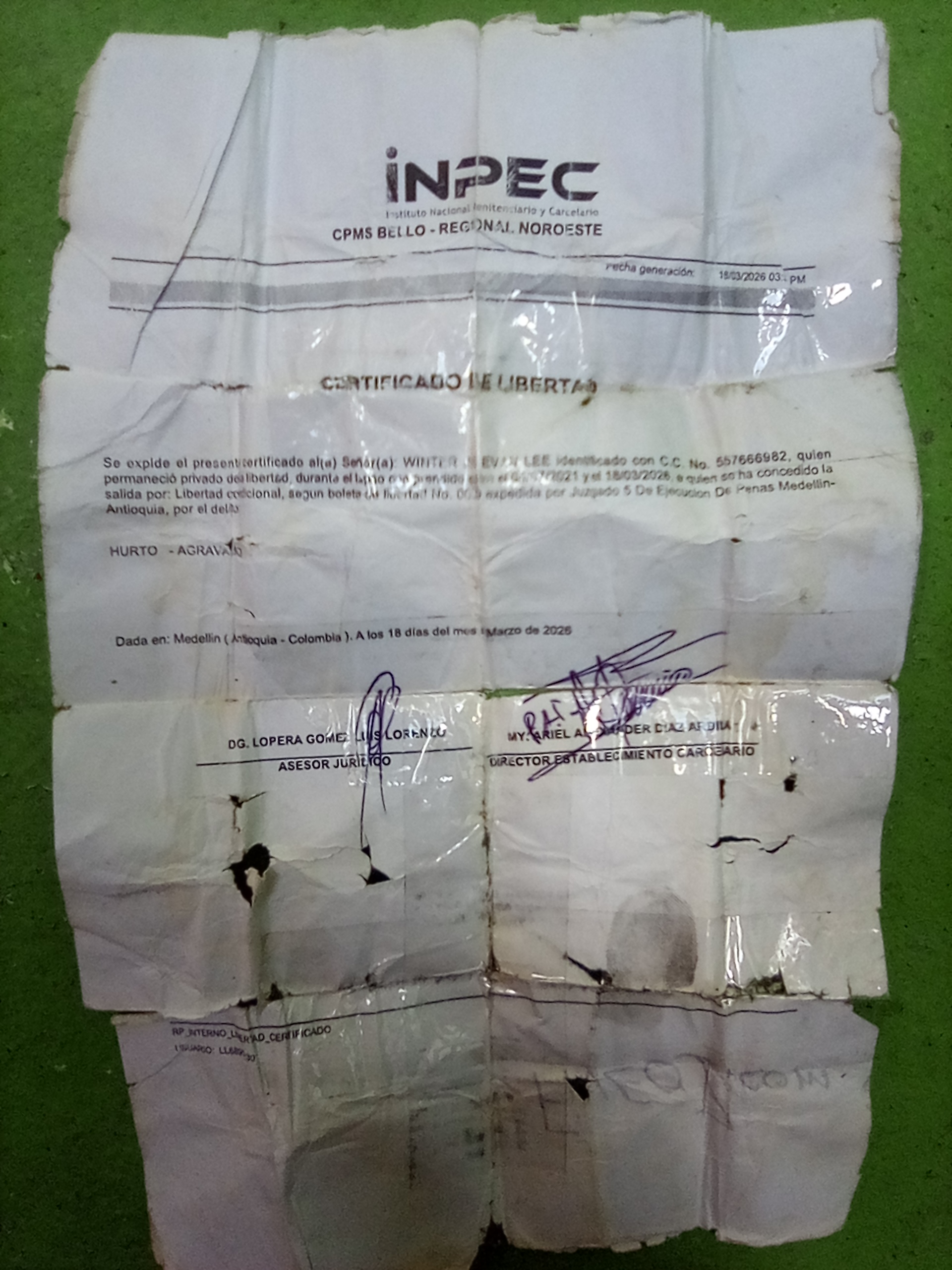
Certificato de Liberta
Bella Vista Medellin Columbia
May 12, 2026
Hammock, marijuana and Boca del Toro
Boca del Toro
May 12, 2026
French toast with syrup
Hostile buco de toro
May 12, 2026
Is chat GPT a bitch
Panama City
May 12, 2026
Chicken fries and Papaya juice
May 12, 2026
Cooking another meal beef onions avocado and papaya
May 12, 2026
Taking a small person boat from the port to buca di Toro
Boca del Toro Panama
May 12, 2026
hojuela achocolatda milk and breakfast another day
Panama City
May 12, 2026
hot spicy chicken and corn sludge for food
Panama City
May 12, 2026
Different money Panama City American Venezuelan Colombian
Panama City
May 12, 2026
They look around the hospital I was staying at in a shot at the Moon
Panama City
May 12, 2026
Marijuana in Panama City
Panama City
May 12, 2026
Another look around the house I was staying at in Panama City
Panama City
May 12, 2026
Taking a small boat from the port to Boca de toro in Panama
Panama
May 12, 2026